

iQuant

Methodology Fórmula de Trade

An analytical, objective and repeatable structure based on seven quantitative pillars for decision-making in financial markets.

Fórmula de Trade

Technical analysis of financial assets can be challenging for people who are beginning to study its concepts. Different approaches, such as Price Action, SMC, Elliott Waves and the Wyckoff Method, along with the various trading timeframes and types of indicators, can raise questions and create confusion. Many of these approaches involve subjective interpretations and require practical knowledge and chart-reading experience, increasing discretion in trading decisions. This can create dependence on market gurus and trading methods presented as miracle solutions, regardless of economic conditions or the characteristics of the asset. Promises of easy money with little or no effort can lure beginners, making it harder to identify credible educational content and useful ways to apply the tools available.

With this understanding, we at iQuant chose to create a clear, objective structure to help you identify and evaluate opportunities through technical analysis. We developed the Fórmula de Trade methodology around fundamental decision-making questions, using the 5W2H framework adapted to trading. This framework brings together seven questions to help traders gain clarity: Why, Where, What, When, Who, How and How Much.

Fórmula de Trade logo
Our Own Methodology
The 5W2H Framework in Trading

Seven fundamental questions for trading clarity

1

[Why & Where] Why and where should you trade? — Understand the context before deciding what to do (Why), including the choice of trading timeframe and asset (Where).

2

[What] What should you use? — After mapping the context, assess which strategy suits the identified conditions.

3

[How] How should you put it into practice? — Once the strategy is defined, understand which setups best suit the conditions and which tools can support their application.

4

[When] When should you proceed? — Even with a defined entry signal, you need confirmation that conditions are suitable for a trade. Liquidity, risk levels and other factors can serve as filters and lead you to reject an opportunity that initially seemed promising.

5

[How Much] How much should you risk, and what is the potential return? — Risk management and trade management rules are crucial and must be defined before entering a trade. Controlling the risk of ruin, which can prevent you from continuing in the market, matters more than pursuing returns.

6

[Who] Who is responsible for all these decisions? — This is one of the most important points: use the methodology to develop autonomy and reduce dependence on gurus and ready-made trading systems. It serves as a guide for developing a trading method with setups, filters and tools suited to your trading profile.

These questions informed the seven pillars of the Fórmula de Trade methodology.

Methodology Diagram

Click the image to expand it in high resolution
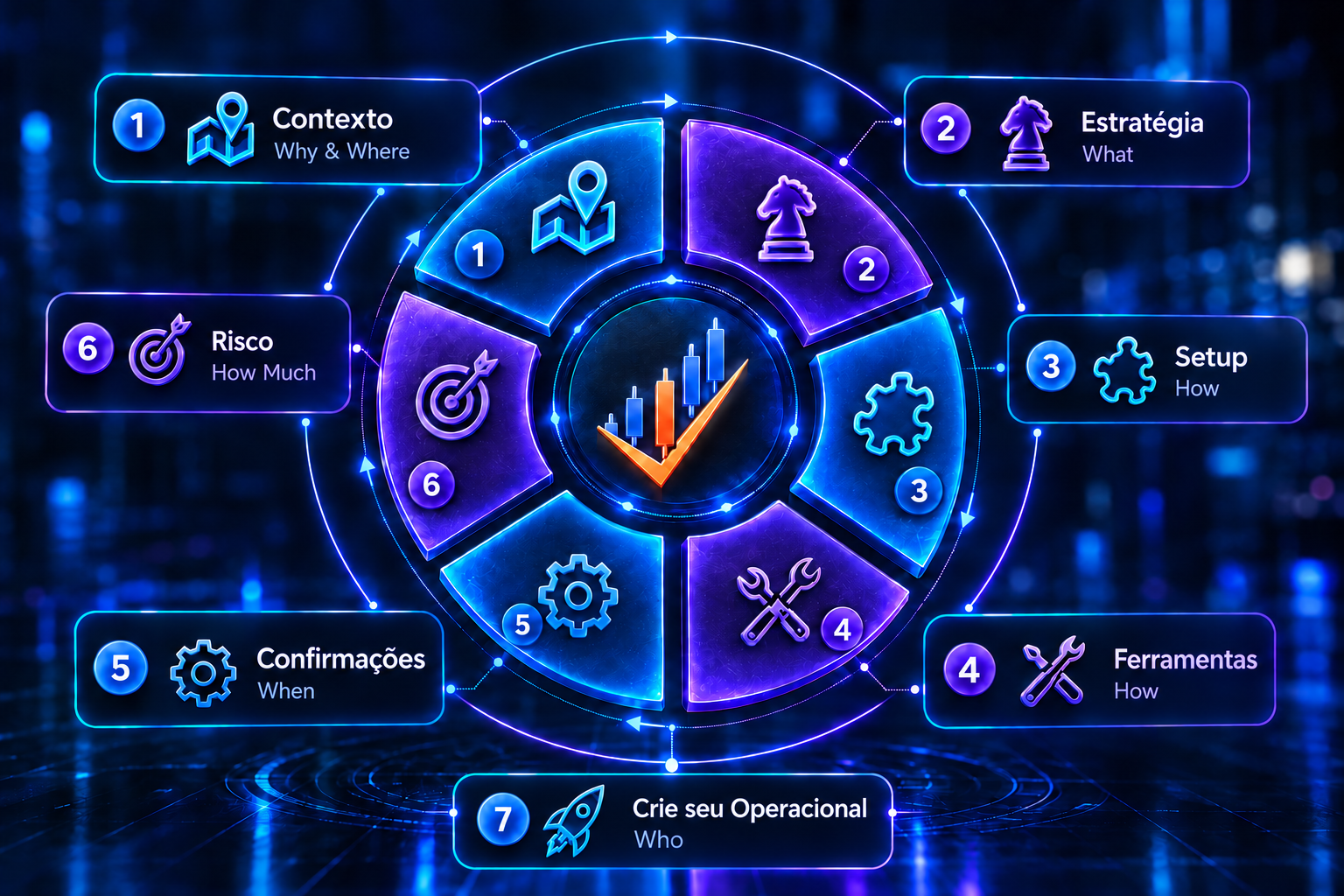
Fórmula de Trade 5W2H diagram (Portuguese)
Click to enlarge

Diagram labels are in Portuguese. The full explanation in English is available in the questions and pillars on this page.

The Seven Pillars of the Methodology

A holistic structure for building your own trading process objectively.

1. Context (Why & Where)

Define your trading timeframe, assess a higher chart timeframe than the one used for the trade, map important price areas and identify the market regime, among other factors.

2. Strategy (What)

Based on the conditions mapped, select a suitable strategy from approaches such as Trend Following, Mean Reversion, Trend Reversal and Breakout, among others.

3. Setup (How)

Choose a setup associated with the selected strategy, giving preference to objective rules that can be applied consistently and repeatedly.

4. Tools (How)

The more objective the setup rules, the greater the opportunity to use technological tools that support their application and help you understand the opportunities and risks involved.

5. Confirmations (When)

A setup entry signal alone is not enough to initiate a trade. Assess criteria such as liquidity, risk levels, the strength of the move and other factors that may influence the trading decision.

6. Risk (How Much)

Using the setup and supporting information, such as support and resistance levels, define entry points, the stop loss and targets, assessing whether the potential return-to-risk ratio is suitable. Also define position size and trade management rules.

7. Your Own Trading Process (Who)

Use this structure to build your own trading method, evaluating its performance against the asset's historical data and your chosen chart timeframe. Run a backtest, even manually, to examine how the selected definitions and rules would have behaved under the conditions studied. You are responsible for your decisions and for applying your trading process consistently.

The main purpose of Fórmula de Trade is to provide a structure to help you create your own trading method objectively, with clarity about how to trade and, above all, autonomy to participate in the market without depending on gurus.

To help you learn more about Fórmula de Trade, we developed Artemis Trade, a course covering the first steps through to backtesting as you build your own trading process using the methodology. Its purpose is to bring clarity to each stage. Use the button below to learn more about the course.

Fórmula de Trade 5W2H diagram (Portuguese)